Saturday, 30 May 2020

What happens to people with 'dependency' in COVID-19 critical care? A look at the ICNARC audit report


There have been consistent worries and reports about potential discrimination against disabled people who contract COVID-19, both in terms of access to critical care in hospitals and in terms of equal treatment once in critical care. As far as I know, there hasn’t been much focus on whether there is evidence to evaluate the presence or potential extent of such discrimination.

One (far from ideal) way to look at this is by looking at the comprehensive (but inaccessible in terms of easy-read) weekly audit reports being produced by the Intensive Care National Audit and Research Centre (ICNARC). ICNARC collects and analyses information about people in intensive/critical care with confirmed COVID-19 from 289 critical care units across England, Wales and Northern Ireland. These weekly audit reports (the information I will refer to here comes from their report of 29th May 2020, with information on people up to 28th May) cover in great detail information about who is admitted to critical care with confirmed COVID-19, what treatment they receive, and outcomes (in terms of whether people died in critical care or were discharged alive, and for some measures 30-day survival after admission).

One of the indicators they report on is ‘dependency prior to admission to acute hospital’. ‘Dependency’ (this measure is not defined) is recorded at three levels:

  • ·        Able to live without assistance in daily activities
  • ·        Some assistance with daily activities
  • ·        Total assistance with all daily activities

Although it is unclear who decides which category to place people into, and on what criteria (is it some kind of frailty assessment, as NICE recommends?), it is the nearest thing I know of to an indicator of need for support for activities of daily living in these kinds of audits. This blogpost will simply look at some comparisons between people not requiring support vs people requiring support, in terms of admission to critical care, access to health interventions once in critical care, and outcomes of critical care.

Admission to critical care

Up to 28th May 2020, the audit reports information on 9,034 people admitted to critical care where there is information on ‘dependency’ (I’m going to call this ‘need for assistance’ from now on). Of these 9,034 people, 8,201 (90.8%) were people with no need for assistance, 802 (8.9%) were people with some need for assistance, and 31 (0.3%) were people with a need for total assistance. The graph shows these percentages, compared to the percentage of people needing assistance admitted to critical care for non-COVID viral pneumonia from 2017-2019.

This graph shows that a smaller proportion of people with COVID-19 admitted to critical care had a need for assistance compared to people in the previous three years with non-COVID viral pneumonia. There are multiple potential explanations to account for this difference (COVID-19 might result in more serious health consequences for a wider range of people across a wider age range than non-COVID viral pneumonia, for example), but there is clearly a difference here.


Treatment for people in critical care

Once people are admitted to critical care, what kinds of treatment do people get? The ICNARC audit focuses on advanced vs basic respiratory support and the presence or not of renal (kidney) support.

The graph below shows the proportion of people not needing assistance getting advanced vs basic respiratory support, compared to the proportion of people needing assistance getting advanced vs basic respiratory support. As the graph shows, 75.7% of people not needing assistance received advanced respiratory support, compared to 57.8% of people needing assistance for daily living.


There was a similar difference in people getting renal support. As the graph below shows, 26.0% of people not needing assistance received renal support compared to 19.2% of people needing assistance.


Outcomes of critical care

The ICNARC audit records whether people with confirmed COVID-19 who had been in critical care either died in critical care or were discharged from critical care alive. Of course, it is possible that people discharged from critical care could die at a later point, and it is important to note that people who stay in critical care for long periods of time are less likely to be recorded in these figures (because they are still in critical care).

The graph below shows that for people not needing assistance, 57.8% of people were discharged alive from critical care. For people needing assistance, 48.3% of people were discharged alive from critical care.


So far, we have seen that people not needing assistance were more likely to receive advanced respiratory support and/or renal support, and more likely to be discharged alive from critical care. Can we disentangle this a little to understand more about what is happening to people? One thing the ICNARC report allows us to do is to look at these outcomes separately for people who did and didn’t receive advanced respiratory and/or renal support.

So, the graph below reports the same outcomes as the graph above, but just for those people who had received advanced respiratory support while in critical care. Of those who had received advanced respiratory support, 48.2% of people not needing assistance were discharged alive, compared to 38.9% of people needing assistance.


And what about those people who did not get advanced respiratory support and only received basic respiratory support in critical care? The graph below shows this information. For people not needing assistance, the vast majority of people (84.9%) getting only basic respiratory support were discharged alive from critical care. This suggests that, for people not needing assistance, people with a more serious COVID-19 condition in critical care received advanced respiratory support.

For people needing assistance, a much lower proportion of people getting only basic respiratory support (56.2%) were discharged alive from critical care. It is unclear why there is this very substantial difference between people with and without a need for assistance.


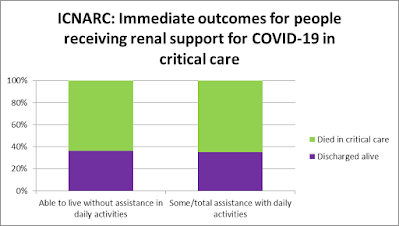
There is a similar, if less extreme, pattern for people who got or didn’t get renal support, as the two graphs below show.  Among those getting renal support, the proportion of people being discharged alive was very similar for people not needing assistance (36.4%) and people needing assistance (35.2%).  Among those not getting renal support, a greater proportion of people not needing assistance were discharged alive (65.3%) compared to people needing assistance (51.3%).


There are clear differences between people needing assistance in daily living and people not needing assistance in daily living when it comes to critical care and COVID-19, according to the ICNARC indicator of ‘dependency’. There are potential differences in access to critical care, differences in access to advanced respiratory support and/or renal support, and differences in outcomes, particularly amongst those people not receiving advanced respiratory support and/or renal support. There are multiple potential explanations for these differences, one of which may be that people needing assistance with daily activities are more likely to be in high-risk groups (for example on grounds of age or health conditions associated with greater risk of a severe reaction to COVID-19). Towards the end of the ICNARC report, the authors report a very useful set of analyses investigating the risk of death within 30 days of entering critical care associated with various factors (e.g. age, ethnicity, area deprivation, body mass index, ‘dependency’) taking all the other factors into account (e.g. the fact that people needing assistance with daily living also tend to be older).

Although as yet only graphs are provided rather than tables of figures, it looks like, for people with confirmed COVID-19 in critical care, if you need assistance with daily living you are somewhere between 1.5 and 2 times more likely to die within 30 days of entering critical care compared to someone who does not need assistance with daily living. This is taking into account age and other risk factors such as obesity. This degree of risk, with the huge exception of age, is as great or greater than any of the other factors investigated in the report (sex, ethnicity, area deprivation, body mass index, immunocompromised, sedated for first 24 hours in critical care).

For all the big differences in access, treatment and outcomes for people needing assistance with daily living that I’ve pulled out of this excellent audit report, I’m not hearing the clamour for rapid reviews, inquiries or action that have rightly been raised when other dimensions of disadvantage have been revealed. Another, material difference as we face the second spike.


Monday, 4 May 2020

A dereliction of death duty

So far in this pandemic (where I suspect we are only at the beginning), in my blogs and social media I have tried to be measured and constructive, trying to provide useful information and analysis and indicate what is possible in terms of types of information urgently needed about people with learning disabilities, autistic people, and disabled people more generally.

So far, we have seen published information and analyses of deaths related to COVID-19 (and often, crucially, all-cause mortality) in England by: age; sex; ethnicity; area deprivation; location; 'dependency'; location of death; care homes (and this is only what comes to mind right now). All of these issues (some of them after some pushing by the media) have been picked up as crucial for understanding potential inequalities, and are triggering rapid reviews and research, and influencing policy and practice.

Meanwhile, published information about COVID-19 and people with learning disabilities, or autistic people, remains (as far as I know) precisely zero. Absolutely nothing. Right from the start of the pandemic, many people have been pushing for information about COVID-19 infections, testing and deaths (both COVID-19 related and of any apparent cause) to be released concerning people with learning disabilities and autistic people. The response from NHS England/Improvement has been a complete brick wall, even it seems to many of their own staff (someone within NHSE/I contacted me recently to ask if I knew of any statistics concerning deaths amongst people with learning disabilities).

And then there was this tweet from Rebecca Thomas at HSJ, who has assiduously been asking questions of NHSE/I for months.


Yes, that does say NEXT YEAR. 2021. Remember, the publication of the first LeDeR report two years ago today (4th May) was the occasion of a huge row, as NHSE/I delayed its publication by several months, published it on the day of local election results, and then tried to claim it had nothing to do with the publication date. 

Before I get to what organisations could do, within 24 hours, to publish information about infection rates and deaths amongst people with learning disabilities (and, for some things, autistic people), here are some urgent questions about the LeDeR programme.

  • What will be the publication date of the 2021 LeDeR report containing the information on COVID-19 deaths amongst people with learning disabilities? No-one knows (by no-one I am referring to the public, including people with learning disabilities and autistic people, as we are clearly the nobodies here).
  • What is the future of the LeDeR programme? No-one knows.
  • The current contract finishes at the end of May (yes, in 25 days' time) - will there be an extension to the LeDeR contract? No-one knows. 
  • Will a contract be signed with an organisation other than the University of Bristol to continue the LeDeR programme, and how can effective handover be expected to happen in this timescale? No-one knows.
  • LeDeR reviews done by NHS Trusts are currently suspended, judged inessential during the COVID-19 pandemic - will they ever resume? No-one knows.
  • Notifications of deaths are still being made to the LeDeR programme (the basis for the secret reporting on deaths) - if there is no contract beyond the end of May, will these notifications just stop being recorded? No-one knows.
  • The LeDeR programme is set up as a 'health improvement' programme (through quangoid HQIP) rather than a research programme, so what happens to all the data from the LeDeR programme - does it have to be destroyed under the terms of the contract? No-one knows.

That NHSE/I is not being straight with the public about any of these questions should be a national scandal.


So - these are things that NHSE/I in particular, and also CQC, could do WITHIN 24 HOURS, to publish information about the impact of COVID-19 on the lives of people with learning disabilities and (sometimes) autistic people.


What NHSE/I can do NOW

1)      NHSE/I have weekly summaries of notifications of deaths to the LeDeR programme, hopefully including both COVID and deaths from any recorded cause (LeDeR notifications collect this information). Publish it NOW.

2)      NHSE/I have told Rebecca Thomas that their reporting of COVID deaths of people in acute hospitals can be broken down by learning disabilities and other 'underlying conditions' (it's a scandal in itself that NHSE/I is saying learning disabilities, or autism, are 'underlying conditions' - showing a revealing lack of understanding). These analyses could start now, and be reported for the whole period retrospectively. Maybe they've been done already and not released? No-one knows.

3)      NHS Digital collect information for NHSE/I on people with learning disabilities and autistic people in specialist and mainstream mental health inpatient units. As yet, I have seen no public data on COVID-19 infections or deaths amongst anyone at all in mental health inpatient services in England. The data are collected continuously and reported on for people with learning disabilities and autistic people monthly:
a.  Commissioners are regularly reporting all sorts of information (including the number of deaths) for the Assuring Transformation dataset. Weekly reports of the total number of people dying in these specialist units can be produced NOW – the proforma that commissioners complete could also be amended to ask for more detail on deaths. At the moment we are hearing about people dying in inpatient units from the local press, rather from the national organisation allegedly responsible for people in these places.
b.  NHS Digital uses the MHSDS (data provided by service providers on all mental health inpatient units) to extract information on people with learning disabilities and autistic people in both specialist and mainstream mental health inpatient units. Could this dataset be used to provide some timely information on the deaths of autistic people and people with learning disabilities in mainstream mental health inpatient units as well as specialist units?


What the CQC can do NOW
The CQC started a little late, but in the notifications of deaths that are required to be sent to them (both in relation to registered social care services, and separately in relation to be detained under the Mental Health Act) they now require information on suspected COVID-19 deaths as well as causes of death recorded on death certificates. This information is now being collated and analysed nationally, with data on care homes used in the national COVID death public reporting and weekly data on the number of people dying in care homes, and through a separate reporting route on the number of care homes with a COVID-19 outbreak. Given the information that CQC already have and publish monthly in their care home directory, it is technically straightforward for CQC to quickly analyse and publish weekly information on:
  1.  COVID-19 and all-cause deaths notified to them, broken down by:
    • Primary care need of the people using the service within which the death took place
    • Age band
    • Type of registered social care service (including care home with nursing, care home, domiciliary care)
    • Location/local authority area (for some types of service), which could also be used for area deprivation indicators
    • CQC ratings (both overall and specific)
    • Number of places (for care homes with nursing and care homes)
    • Organisation running the service
For speed, an analysis of COVID-19 and all-cause deaths of people using social care services supporting people with a primary care need of learning disabilities or autism, broken down by type of social care service and broad age band, could be done first.

     2.  COVID-19 and all-cause deaths notified to them of people detained under the Mental Health Act. This could be done quickly, followed by analyses broken down by ward type according to CQC inspection regimes.

All of the above analyses either have been done secretly, or could be done (and published) straightforwardly.

As I said at the start, I really have tried to be constructive and measured since the start of the COVID-19 pandemic about the lack of information concerning COVID-19 and all-cause deaths of people with learning disabilities and autistic people. All sorts of people and organisations have been scrambling to get sensible information collected and analysed, at unparalleled speed, in very difficult circumstances. 

But this level of wilful obstruction in making basic information available about these groups of people, while ever-more detailed and nuanced information is available on so many other aspects of COVID-19 infections and deaths, really makes me think NHSE/I are trying to hide something. As John Dean, White House Counsel turned whistleblower, said to President Nixon during Watergate "It's not the crime; it's the cover-up that can get you in real trouble."


Thursday, 16 April 2020

What is happening to people with learning disabilities and autistic people in inpatient units under Covid-19? Early signs from Assuring Transformation


In this blogpost I’m going to take a quick look at the latest NHS Digital data released on 16th April 2020 about people with learning disabilities and autistic people in inpatient units. I’m going to focus on the Assuring Transformation data, which is the fairly restricted dataset NHS England uses when reporting on the Transforming Care programme designed to reduce the number of people in inpatient units and support more people effectively outside of inpatient units.

I’m focusing on this dataset because the reporting is rapid – the data released today has been provided by commissioners for March 2020 – although because commissioners can and do report retrospectively the information will be incomplete. I want to see if there are any early signs that Covid-19, or the way that services are responding to it, is making any difference to what’s happening with people in inpatient units. Most health service commissioners are still reporting information – 94% of commissioners for March 2020 (not all commissioners, as they can report retrospectively, report data every month), which is comparable to much of the past year.

In terms of the total number of people recorded as being in inpatient units, this dropped from 2,170 people in February 2020 to 2,095 people in March 2020. On the face of it this looks like the biggest monthly drop in numbers of people for at least a year (and probably longer), but the number of people reported to be inpatient units in March 2020 is likely to increase as more people are added to this total retrospectively. Most of this apparent decrease has come in NHS inpatient units (1,120 people in Feb 2020 vs 1,050 people in March 2020) compared to independent sector units (1,030 people in Feb 2020 vs 1,005 people in March 2020).

If we take this reduction in the number of people in inpatient units at face value, why might it be happening?

Well, the headline numbers on the number of admissions (people going into inpatient units and also people transferred between inpatient units) suggests a substantial drop in the number of admissions in March 2020 (90 admissions) compared to February 2020 (130 admissions) and much of the previous year (between 145 and 195 admissions per month). Of the 90 people admitted in March 2020, for 55 people it was the first admission to an inpatient unit in at least a year (compared to 70 people in Feb 2020), for 10 people they had previously been in an inpatient unit less than a year before (vs 25 people in Feb 2020), and 25 people were directly moved from one inpatient unit to another (vs 30 people in Feb 2020). In March 2020, 40 people had been admitted to the inpatient unit from their ‘usual place of residence’ (vs 60 people in Feb 2020), 5 people from a ‘temporary place of residence’ (vs fewer than 5 people in Feb 2020), 20 people from ‘acute beds’ (vs 35 people in Feb 2020) and 20 people from an ‘other hospital’ (vs 25 people in Feb 2020). Relatively few people admitted had a pre-admission Care and Treatment Review (30 people in March 2020) and no-one had a post-admission Care and Treatment Review. Are these the beginning signs of inpatient units admitting fewer people?

The other thing to look at is how many people are being ‘discharged’ from inpatient units and what their destinations are. Mercifully, the number of deaths of people in inpatient units recorded in these figures (as a type of ‘discharge’, which is rather crass) in March 2020 remained, as it has in all other individual months, an asterisk (this means that were anything between 0 and 4 deaths in the month). This will repay particularly close attention in the coming months.

Overall, 185 people were ‘discharged’ from inpatient units in March 2020 – this is an increase on February 2020 (170 ‘discharges’), but within the fluctuating number of discharges recorded month by month over the previous year (between 160 and 205 in any one month). In the world of Assuring Transformation a ‘discharge’ can actually mean a transfer direct to another inpatient unit – this happened to 20 people in March 2020 and is the lowest figure recorded for any single month in the past year (and probably longer). The number of people being discharged to ‘community’ settings (120 people in March 2020) is within the fluctuations recorded over the previous year or so (between 105 and 155 people in any one month). 10 people went to ‘independent living’, 50 people went to ‘supported housing’, 35 people went to their ‘family home with support’, and 20 people went to ‘residential care’ – similar figures to previous months. Finally, 45 people in March 2020 went to a mysterious ‘other’ setting, a much higher figure than in February 2020 (25 people) and a higher monthly figure than any month over the past year or so.

Overall, with retrospective reporting and March being early in the Covid-19 pandemic in England, the Assuring Transformation data does not show signs of drastic upheavals in the inpatient unit system or detectable consequences (yet) of Covid-19 on autistic people and people with learning disabilities in inpatient units. There might be some early signs of inpatient units hunkering down in preparation for Covid-19, and the increase in people discharged to ‘other’ places needs investigation. It will be worth following this dataset (and the MHSDS, which has a longer time lag to the release of information) closely to see what is happening to people.

Monday, 13 April 2020

Recording and analysing COVID-19 related deaths amongst people getting social care and disabled people – what should be possible in England?


Recording and analysing COVID-19 related deaths amongst people getting social care and disabled people – what should be possible in England?

13th April 2020

As the number of people recorded as dying from COVID-19 related causes in official statistics in England continues to rise rapidly, there are increasingly vocal and urgent concerns being expressed that the daily figures released by NHS England:

1) Considerably underestimate the number of people dying from COVID-19 related causes in England, because they are focused solely on deaths of people in hospitals.
2) Are ignoring what are likely to be substantial numbers of people in care homes dying of COVID-19 related causes, where emerging international evidence (see, for example, this excellent summary from Adelina Comas-Herrera and Joseba Zalakain, which reports data from Belgium, France, Ireland, Italy and Spain that 42%-57% of ALL COVID-19 related deaths are people living in care homes).
3) Are ignoring the potential for COVID-19 deaths to be hitting certain groups of people harder than others, for example different groups of disabled children and adults. Data are now starting to be analysed by age, gender and ethnicity, but little seems to be available beyond these (important) characteristics.

Many people getting social care, their family members, and those supporting them are expressing alarm about what is happening, including: usual social care being reduced or withdrawn, a lack of personal protective equipment, physical separation of people from family members, a decimated workforce with little back-up support, uncertain support for daily needs like food when people and families are in self-isolation or ‘shielding’, worries about whether people will get access to the same healthcare as others if they become ill with COVID-19, the lack of testing for COVID-19 amongst people using social care, their families and support workers, and policies such as attempting to move recovering people, still with COVID-19 symptoms, into care homes from hospitals.

It is important to remember the sheer number and diversity of people using long-term social care in England, and the diversity of social care that people are getting/using. Over the course of 2018/19, 841,850 adults aged 18+ in England were getting some form of long-term social care. While almost two-thirds were people aged 65+ (65%, 548,435 people) almost 300,000 people (293,415 people) getting social care were aged 18-64. And social care is so much more than nursing or residential care homes – while there were over a quarter of a million people in nursing or residential care homes (261,665 people, although this figures excludes people funding their own social care), this represents less than one third (31%) of adults getting social care. Finally, it is worth noting that, while most people in nursing or residential care homes were people aged 65+ (215,650 people), substantial numbers of younger adults aged 18-64 (46,015 people) also live in nursing or residential care homes.

The invisibility of different groups of people using different forms of social care within COVID-19 death statistics will mean that policies and practices that are potentially disastrous for particular groups of people will not be identified and changed until it’s way too late (for many people, it is already be too late). As we have seen from the experiences of different countries so far, what countries decide to do can have a massive impact on who gets COVID-19 and what happens to them when they do.

In this blogpost, I’m going to try and set out my understanding of potential sources of information on COVID-19 related deaths amongst people using social care in England. Because of my limitations this will be an England-centric blogpost (other parts of the UK are reporting some information in slightly different ways), and a couple of the sources of information will be specific to people with learning disabilities (although most of them aren’t). These are just my ideas from looking around and from many people alerting me to potential sources of information rather than any inside knowledge. 

This is also a snapshot in time (13th April 2020) which I hope will become outdated very quickly as this kind of information begins to be published very rapidly. I am also highly likely to have made mistakes and would welcome corrections. I will go through different sources of information, outlining what I think their potential is for:

1) Recording and analysing the deaths of people in different living circumstances (particularly people getting/using social care), such as care homes or people getting direct payments
2) Breaking down information on deaths by particular groups of people, for example different groups of disabled people.

NHS England
These are the headline figures released every day. As NHS England report them, they are raw numbers of people in NHS hospitals (from the list of NHS Trusts reported with the statistics, it looks like this excludes people in inpatient units in specialist mental health NHS Trusts and people in independent sector inpatient units/hospitals) who have died and who have tested positive for COVID-19. Deaths are reported retrospectively, so a day’s figures might include people who died the day before, a week before and so on.  

As NHS England acknowledge, these will be not be complete figures for those dying COVID-19 related deaths. First, they only include people dying in acute hospitals – although people will have been living elsewhere, including in care homes, I’ve not seen the NHS deaths data broken down in this way. Second, they only include people who have been tested, and tested positive, for COVID-19. Although testing is more widespread in acute hospitals than elsewhere, there will be some people with suspected COVID-19 who have died in an acute hospital, who wouldn’t be included in these figures.

NHS England have stated to Rebecca Thomas, a journalist for the Health Service Journal, that they do track the ‘pre-existing conditions’ of people in their COVID-19 death figures, including ‘conditions’ such as learning disability, but that they have ‘declined to share this data’.


Public Health England
Public Health England (PHE) has an online coronavirus tracker, which displays the number of confirmed cases of COVID-19 and the number of confirmed COVID-19 related deaths and can be broken down by various geographies. As far as I can tell, this online tracker uses the same information as the NHS England count of deaths and is subject to the same limitations in terms of hospital location and the restrictions of the COVID-19 testing programme. However, if NHS England can break this down by ‘pre-existing conditions’ presumably PHE can too.

Office for National Statistics
The Office for National Statistics (ONS) has started to generate information updated weekly on deaths related to COVID-19. The source of their statistics is different to the NHS England data – the ONS base their statistics on the number of registered deaths where COVID-19 has been mentioned anywhere on the death certificate. This takes longer to prepare than the daily counts from hospitals (11 days after the week’s registration data), but is broader in scope in that it includes people outside hospitals and also people who haven’t been tested for COVID-19 but where a medical professional completing the death certificate was sufficiently confident in a diagnosis of COVID-19 that they mentioned it on the death certificate.

In their analysis of deaths registered in one week up to 27 March, ONS report that there were 539 COVID-19 related deaths in total, of which 501 (93%) occurred in an acute hospital, 20 (4%) occurred in care homes and 15 (3%) occurred in the person’s own home. It is important to note both the time lag and also that this records the place of people’s deaths rather than where people were living when they contracted COVID-19 (at this relatively early point in the pandemic in the UK it is possible that people in care homes were being admitted to acute hospitals, which may not be happening as the pandemic fully hits).

The ONS also provides breakdowns of COVID-19 death data by age band, sex and region. As the data are derived from death certificates, presumably linkage to other databases would be required to make it possible to conduct analyses according to disability or co-occurring health conditions not mentioned on the death certificate.

Intensive Care National Audit and Research Centre
The Intensive Care National Audit and Research Centre (ICNARC) regularly collects audit data from hospital critical care units in England, Wales and Northern Ireland. They have been collecting information on people with confirmed (tested) COVID-19 admitted to critical care units, and have published their most recent report on the situation up to 9th April here. In terms of scope this is a restricted group of people, in that everyone has a confirmed COVID-19 diagnosis via testing and has been admitted to hospital critical care. However, this dataset also includes information on people who have survived COVID-19 to the point of leaving critical care as well as people who have died in critical care, and the report includes a lot more information on people coming into critical care with COVID-19, such as age, sex, ethnicity, Body Mass Index, pregnancy, very severe health comorbidities, and something called ‘dependency prior to admission to hospital’, scored as ‘Able to live without  assistance vs needs some assistance with daily activities vs Needs total assistance with all daily activities’ (93.2% of people admitted to critical care with confirmed COVID-19 were able to live without assistance, 6.7% of people needed some assistance, and 0.1% of people needed total assistance).

ICNARC report some analyses of what treatment people get (for example whether people get advanced respiratory support vs basic respiratory support) and people’s outcomes (leaving critical care alive vs dying in critical care) by the characteristics I’ve mentioned above. If I’m reading the tables right, 71% of people needing no assistance got advanced respiratory support vs basic respiratory support in critical care, compared to 62% of people needing assistance. Just over half of people needing no assistance with daily living (50.5%) left the critical care unit alive, compared to just over a third (37.3%) of people needing assistance.

Clearly the information from ICNARC is limited in scope, but it is reporting analyses looking at different processes and different outcomes across different groups.

Royal College of General Practitioners Research and Surveillance Centre COVID-19 Surveillance
The Royal College of General Practitioners (RCGP) has a research and surveillance centre which, with the University of Oxford, is recording suspected, confirmed and excluded cases of COVID-19 reported by general practices within the surveillance network. This is open to all GP practices in England, with COVID-19 codes added to GP computerised medical record systems, and a summary of the results is published weekly. In this coding system, ‘confirmed’ cases include people where there is ‘hard evidence’ of an infection. The definition of ‘suspected’ cases is quite expansive, including people who have recently travelled to high-risk areas or are in close contact with someone with COVID-19. As this database is sourced from general practices, it should cover people in all living situations, including nursing/residential care homes and supported living, although data linkage with social care records nationally would be required for most of these analyses to be conducted.
As yet, COVID-19 related deaths have not been publicly reported using this source of information. Suspected, confirmed and excluded cases can be analysed by broad geographical region, age band, and ‘patient category’ (pregnant, risk group, other).  Presumably, as this information is based on GP records, other information on GP records (such as whether people are registered by GPs as a person with learning disabilities or an autistic person) could be cross-referred against the information collected here.

Care Quality Commission Notification of Deaths
Since 2009, there has been a statutory requirement for service providers to notify the Care Quality Commission (CQC) of the deaths of people using those services regulated by the CQC in England. The CQC has recently altered its death notification forms to include whether the person’s death related to confirmed or suspected coronavirus. This source of information has the potential to provide detailed information on COVID-19 related deaths amongst people likely to be under-represented in the sources of information outlined so far. First, one set of forms is completed by social care providers for people getting/using social care in England across the whole age range. A different set of forms is completed by independent healthcare providers for people in their services and detained under the Mental Health Act. Second, the death notification forms ask for quite a lot of information that is vital for disentangling both where people lived (the service provider) and where they died (for example at home, at hospital, in a hospice etc), and the cause of death on the death certificate vs whether the person was suspected or confirmed to have coronavirus. Third, the type of registration of different services with the CQC would allow some analysis of the experience of different groups of people in relation to COVID-19 (bearing in mind that a single service can have multiple registrations).

I have not seen any analyses from this dataset yet, and I am unclear how well social care service providers are managing to complete death notification forms if their services are under extreme pressure, but it potentially seems a really important, complementary source of information. It should also be recognised that coverage from this dataset will also miss out important groups of people using social care, such as the more than 100,000 people getting social in the form of a direct payment.

The LeDeR programme
The LeDeR programme has been set up and has been running for some time to build an England-wide system for recording the deaths specifically of people with learning disabilities. While LeDeR reviewing activities have been suspended during the COVID-19 pandemic, notifications of deaths into LeDeR from any source are still happening and a question about whether the person was suspected or confirmed to be infected with COVID-19 has been added to the form. If people are still reporting people’s deaths to LeDeR, the scope of this source of information is potentially broader in terms of people’s living circumstances than any of the other data sources mentioned in this blogpost (although obviously restricted to people with learning disabilities).

Even without a LeDeR review, the information on notification forms could provide very useful information and analyses of how many deaths of people with learning disabilities are potentially related to COVID-19, where people lived and where they died, and some basic characteristics of the person.

As NHS England is ultimately in control of information coming out of the LeDeR programme, their attitude towards timely and transparent publication of potentially valuable LeDeR information (given their attitude towards the data at the top of this blogpost) does not inspire me with confidence.

Social care service providers
In some places, such as New York in the USA, consortia of large social care service providers have been compiling their own information about people with suspected or confirmed COVID-19 and COVID-19 related deaths. I have heard of at least social care service provider in England that is doing something similar, and I’m sure there are more. With some support from analysts, collating and publishing information from service provider organisations could be a really valuable complement to what is being reported (or not being reported) elsewhere.

Local authorities collecting data directly from service providers
There are also some local authorities in England who are attempting to collect information on COVID-19 infection and death rates, and workforce issues, frequently and directly from social care service providers. Linked to other local authority social care information, this has the potential to track the impact of COVID-19 rapidly and in local detail to inform local planning and decision-making. Whilst there may be issues in social care providers being able to deliver this information at points of extreme pressure, and these sets of information will not produce national figures, they can be of immense value for local decision-making, inform areas where COVID-19 pressures may hit later what the issues are likely to be, and provide the basis for tracking people and supports over time.

Assuring Transformation
This may seem rather niche, but NHS Digital reports data on a monthly basis concerning people with learning disabilities and autistic people in specialist inpatient units (both NHS and independent sector) commissioned by NHS commissioners in England. This includes a line (under ‘discharge’, believe it or not) on the number of deaths of people in inpatient units in the month being reported. In the years I’ve spent looking at this dataset, due to the suppression of numbers below five, no single month has yielded five or more deaths of people in these units. If COVID-19 rips through inpatient units, it might be seen here (although specific causes of death are not reported).

Citizens’ records of deaths
In the absence of public reporting of the deaths of particular groups of people related to COVID-19, some citizens have set up open-sourced, online ways for people to report people’s deaths (with an option for a brief memorial to that person if they wish). For example, George Julian has set up a way for people to record the deaths of people with learning disabilities.

Conclusions
Current publicly available information concerning COVID-19 related deaths in England is extremely limited, both in scope (currently largely confined to people in acute NHS hospitals) and in terms of analyses to make visible, understand, and ultimately do something about those inequalities which many people are rightly very concerned about. Hopefully this blogpost shows that there are sources of information that can be used to get much better information about COVID-19 amongst people using a range of social care services and supports and amongst groups likely to experience discriminatory practices, such as disabled people.

It is important to note that information systems take time and dedication to set up and maintain, and limitations in their scope, coverage and capability for analysis are to be expected and understood rather than lamented for the lack of an illusory ‘perfect’ recording system. What is vital is maximum transparency and maximum speed of publication so this information can be used for action, rather than for sophisticated hindsight when it’s too late.

Monday, 30 March 2020

Health condition does not equal Vulnerability does not equal Need for Support

Sorry - blog overload here. This will be a quick one. Again, because the statistics I know how to find more quickly are about people with learning disabilities, this is what I will focus on here. But, as Katie Clarke (@katietraining) has pointed out very forcefully, these are not issues specific to people with learning disabilities, with some nuanced differences they will apply to many groups of disabled people in similar situations. A collective response and push that unites people is most likely to make a difference.

As discussed in my previous blogpost, the government guidance on social distancing defines groups at 'increased risk of severe illness from COVID-19' in terms of age (70 or older), a set of individual health conditions, being pregnant, and/or a 'chronic neurological condition' where learning disability is specified as one of these conditions. There is also government guidance on 'shielding and protecting people defined on medical grounds as extremely vulnerable from COVID-19' ('shielding' involves at least 12 weeks of rigorous self-isolation) - people in this group are defined by a series of discrete medical/health conditions.

What do I think some of the consequences are of this for people with learning disabilities?
1) Although people with learning disabilities are more likely to be experiencing some of the health conditions associated with 'vulnerability', placing 1.1 million people with learning disabilities in England into a 'vulnerable' group in a blanket sense rather than on the basis of health conditions that people may have seems excessive.
2) Defining 'vulnerability' and 'extreme vulnerability' in terms of a set of individual medical conditions means that many people with learning disabilities with multiple health conditions (none of which individually are on the list) and need for 24-hour care support do not meet this 'extreme vulnerability' threshold while actually being at substantial risk in terms of the consequences of COVID-19.

Why does defining 'vulnerability' in this way matter?
1) Given the consequences of emerging guidelines about how disabled people may be treated by hospital services if they have COVID-19, many people are worried about identifying themselves officially as 'vulnerable' or 'extremely vulnerable'.
2) Being defined as 'vulnerable' in the government strategy may a factor that hinders people with learning disabilities from volunteering and helping others, which many people want to do and are in an excellent position to do.
3) To get 'extra support' if you are in self-isolation, you need to register with the government as a 'clinically extremely vulnerable person' (although to be honest many people will be trying to get support from their local communities to avoid their names being on such a register). And as I've outlined above, many people with learning disabilities who need this 'extra support', even on health grounds, will not reach the medically defined threshold for getting it.

I think the issue of who needs 'extra support' (or some help from other people - which we all do, all the time, in different ways) needs to be decoupled from whether a person has one or more specific medical conditions. Just a quick look at the range of living situations that people with learning disabilities are living in suggests that many people might want some different help (and might want to make a contribution), as the routines of daily life and connections with other people have changed so radically and many people with learning disabilities may for financial and being controlled reasons not have the kind of access to technology to connect regularly with other people and the world in general. Many families of people with multiple health conditions are working flat-out in caring for their family member, with diminishing and changing support teams as COVID-19 hits, while worrying about what will happen to their direct payments and other suspended rights to support when the Coronavirus Bill takes effect.

For example, just looking at the number of adults with learning disabilities getting long-term adult social care gives a sense of how many people and families might need 'extra support' that may not be due to a medical condition but absolutely needed to help people through while reducing the risk of a person getting COVID-19 in the first place. In 2018/19, well over a third (37%; 49,170 people) of all adults aged 18-64 with learning disabilities in England were living with their families. Almost a quarter of people (22%; 29,170 people) were in some form of supported accommodation and more people were in tenancies of various forms, where social care support may be limited anyway and particularly disrupted at the moment. Only 16% of working age adults with learning disabilities (21,150 people) getting long-term social care were living in residential care, which seems to be the main focus of government social care strategy concerning COVID-19. And this is not including the 17,045 adults with learning disabilities aged 65 or over getting some form of long-term social care, the likely much larger numbers of adults with learning disabilities not recognised as such by health or social care, the almost 70,000 children with learning disabilities in school, or the more than 30,000 children with learning disabilities who are looked-after children.

Within all these groups of people (and for most people, their families too), and for many more groups, there will be many people who whom 'extra support' will be essential to help people get through. I can't emphasise enough that a centralised state response to all these people is not necessary or even desirable - there are so many good local initiatives that are in a better position to include people. But people and families need urgent support now, that isn't dependent on reaching a 'medical' threshold, and that works with individuals to support people with what they need in ways that are flexible, anti-bureaucratic, reliable and reassuring. Health condition does not equal vulnerability does not equal need for support.

Saturday, 28 March 2020

Potential risk factors for the impact of COVID-19 on health: People with learning disabilities


Potential risk factors for the impact of COVID-19 on health: People with learning disabilities


In this blogpost I want to set out some evidence related to people with learning disabilities and the potential impact of COVID-19 on people’s health. This is a separate issue from which factors might influence the likelihood of people with learning disabilities getting infected with COVID-19 – this blogpost is about the extent to which people with learning disabilities have co-occurring health issues that make the impact of COVID-19 potentially more serious.

The UK government has set out a list of groups which it considers to be at greater risk in terms of the potential impact of COVID-19 on people’s health, recommending that people in these group exercise social distancing and for some conditions self-isolation[1]. People with learning disabilities are included as a blanket group in this list as an example of a ‘chronic neurological condition’. There has also been more recent guidance[2] where “people defined on medical grounds as extremely vulnerable from COVID-19” have been advised to ‘shield’ themselves in self-isolation for 12 weeks – the list of medical conditions do not explicitly include people with learning disabilities as a blanket group.

How many people with learning disabilities are there in England?

People with learning disabilities as a whole are a big and very diverse group of people. The most recent estimate of the total number of people with learning disabilities in England, derived from 2015 figures and estimates[3], was almost 1.1 million people (1,087,100 people). Most people (930,400) were adults, with over three-quarters (77%) likely to be not known as such to health or social care services. In 2020 that overall number is likely to be bigger[4], although education and adult social care services have not kept pace with the increasing numbers and needs of some groups of people with learning disabilities[5].

In terms of people with learning disabilities recognised by services to the point of getting some form of meaningful support, in 2018 there were 67,765 children with an Education Health and Care Plan and a label suggestive of learning disabilities (Moderate Learning Difficulty – 28,241 children; Severe Learning Difficulty – 29,492 children; Profound Multiple Learning Difficulty – 10,032 children)[6].

In 2018/19 there were 133,575 adults with learning disabilities aged 18-64 and 17,045 adults with learning disabilities aged 65+ getting some form of long-term social care, a total of 150,620 adults. In 2018/19 a larger number of 297,174 people with learning disabilities of all ages were registered as a person with learning disabilities with their GP[7].

What are the potential risk factors for COVID-19 potentially having a greater impact on the health of people with learning disabilities?

There is still a lot of uncertainty about what might be linked to having a poorer reaction to COVID-19 if you catch it. It is also really important to say that we are talking about probabilities here for groups of people – it you are in a group at greater overall risk that does not at all guarantee that you will have a worse reaction to COVID-19 (and being in a low risk group does not guarantee that you will have a better reaction).

Based on the list of provided by the UK government in its social distancing guidance, what do we know about how common these risk factors are amongst people with learning disabilities?

Age – the general message seems to be that older people are more susceptible to COVID-19. Because of a range of factors, including how people with learning disabilities can be treated (or mistreated, or not treated) by health services[8], there are proportionally fewer people with learning disabilities in older age groups although (thankfully) the number of older people with learning disabilities has been increasing. For some groups of people with learning disabilities potential risk factors will be present either from birth or from an earlier age than the population generally, so younger people and those supporting them as well as older people should be getting the best support and healthcare.

There is also an emerging picture that more men than women are more likely to become more ill with COVID-19. A consistent international finding is that more men than women are identified with learning disabilities.

[Added 30/3/2020]. Finally, smoking appears to be associated with more serious consequences of COVID-19. Although good evidence on rates of smoking amongst people with learning disabilities is scarce, it appears that people with learning disabilities who are eligible for and using long-term social care support may be less likely to be smokers than the general population, whereas people with learning disabilities (including adolescents) who are less likely to be eligible for long-term social care support may be more likely to be smokers than the general population.

People with learning disabilities registered with GPs

From 2014/15, NHS Digital every year has been publishing information from around half of GP practices in England, comparing people with and without learning disabilities on what GPs record about people’s health and selected aspects of their treatment. Although geographical coverage is patchy, you can also get detailed information area by area[9]. Overall, it is important to say that this database is reporting that people with learning disabilities are 4 times more likely to die than people without learning disabilities of the same age and sex.

What does this database (and research, much of which is summarised by Public Health England here[10]) say about whether people with learning disabilities are more or less likely than other people to experience the risk factors associated with ‘vulnerability’ to COVID-19? Overall, the general pattern is that people with learning disabilities are more likely to experience a range of risk factors at younger ages than other people, but are less likely to be living long enough to experience risk factors or health conditions that are common amongst over-75s.

Respiratory conditions are obviously an important risk factor in relation to COVID-19. The GP database reports:
·         Asthma: overall 9.2% of people with learning disabilities vs 5.8% of other people, with asthma more common amongst people with learning disabilities in all age groups up to 64 years old.
·         Chronic Obstructive Pulmonary Disease (COPD): overall 1.2% of people with learning disabilities vs 1.8% of other people, but more common amongst people with learning disabilities in age groups 35-54 years.

It is absolutely crucial to note that respiratory diseases, particularly pneumonias including aspiration pneumonia, are possibly the leading cause of death for people with learning disabilities and are much more common amongst people with learning disabilities than amongst other people[11].

[Added 30/3/2020, after a prompt from Jane Bernal.] People with Down syndrome are more likely than people with learning disabilities generally to experience more serious consequences of respiratory infections.

One of the major risk factors for aspiration pneumonia is dysphagia (problems with swallowing), which is not on the government’s list of ‘vulnerabilities’ but is common amongst people with learning disabilities and increases with age. GP recording of dysphagia amongst people with learning disabilities is improving but still only stands at 5.8% of people, where research suggests a much higher rate of around 14%[12]. Related health issues that are not in the government list but are an issue for many people with learning disabilities are constipation (GPs report this for 13.1% of people with learning disabilities, but research suggests much higher rates of constipation, and unrecognised constipation can have fatal consequences) and Gastro-Oesophageal Reflux Disease (GPs report this for 9.8% of people with learning disabilities).

Another major set of risk factors concerns the heart and circulatory system. The GP database reports:
·         Heart failure: overall 1.0% of people with learning disabilities vs 1.0% of other people, but heart failure is more common in people with learning disabilities in all age groups up to age 74 years.
·         Coronary heart disease: overall 1.1% of people with learning disabilities vs 2.8% of other people, largely because CHD is far more common amongst older people.
·         Hypertension: overall 9.8% of people with learning disabilities vs 12.8% of other people, but hypertension is more common amongst people with learning disabilities aged 25-54 years.
·         Stroke or Transient Ischemic Attack: overall 1.6% of people with learning disabilities vs 1.6% of other people, but stroke or TIA is more common amongst people with learning disabilities of all ages up to age 74 years.

Again, circulatory diseases are a leading cause of death amongst people with learning disabilities[13].

A range of other ‘vulnerabilities’ including the following, as reported by the GP database:
·         Type 1 diabetes: overall 0.8% of people with learning disabilities vs 0.4% of other people, more common amongst people with learning disabilities up to the age of 74 years.
·         Non-Type 1 diabetes: overall 7.0% of people with learning disabilities vs 4.8% of other people, more common amongst people with learning disabilities at all ages.
·         Cancer: overall 1.6% of people with learning disabilities vs 2.8% of other people, but more common amongst people with learning disabilities at all ages up to age 44 years.
·         Chronic Kidney Disease: overall 2.9% of people with learning disabilities vs 3.0% of other people, but CKD is more common amongst people with learning disabilities from age 25 to 74 years.
·         Being seriously overweight: in the government guidelines a Body Mass Index of 40+ is stated as a ‘vulnerability’ factor. The GP database only reports on people with a BMI of 30+ - this reports 37.5% of people with learning disabilities with a BMI of 30+ vs 30.1% of other people, with these BMIs more common amongst people with learning disabilities at all ages up to 54 years.

Although definitions vary, it is clear that ‘multimorbidity’ (experiencing more than one long-term health condition) is much more common amongst people with learning disabilities, beginning at much earlier ages than the general population.

People with profound and multiple learning disabilities in England

Although there is much less evidence than there should be, it is clear that people with profound and multiple learning disabilities are much more likely to experience the risk factors for susceptibility to COVID-19 than other groups of people with learning disabilities. In England, this is estimated to be 10,969 children in schools[14] and 18,925 adults[15].

The kind of information I’ve described above from GPs is not available specifically for people with profound and multiple learning disabilities, and even international research evidence on the health of this group of people is lacking. A review of the international research evidence[16] could not always produce overall estimates of health conditions because the research evidence was too diverse, but it reports the following for people with profound and multiple learning disabilities:
·         21% of people with profound and multiple learning disabilities experience respiratory disease.
·         30% of people with profound and multiple learning disabilities experience dysphagia.
·         Much higher rates of cardiovascular health problems and hypertension.

Issues that are particularly important for people with profound and multiple learning disabilities, such as tube feeding and much higher rates of epilepsy[17] (which is much more common in people with learning disabilities generally compared to other people, with GPs reporting 17.3% of people with learning disabilities experiencing epilepsy compared to 0.6% of other people), are not listed as ‘vulnerability’ factors but are likely to be really important for this group of people.

COVID-19 and people with learning disabilities – redressing an injustice or making it worse?

The evidence is clear that people with learning disabilities are more likely to experience a range of health conditions associated with a greater likelihood of a more severe reaction to COVID-19 infection. Even when overall rates of a particular health condition are similar between people with and without learning disabilities, people with learning disabilities are more likely to be experiencing these conditions are earlier ages. There are also particular groups of people with learning disabilities at particularly high risk of having a poor reaction to COVID-19.

Extensive research also shows that people with learning disabilities, as a group, experience systematic inequities when it comes to health – both in experiencing the social and economic conditions likely to result in poorer health, and in the (non-)response of health services to people’s health needs[18]. Now, when it really matters, there is an opportunity to begin to redress this injustice. Is everything possible being done to support people, families and support services such that the risk of COVID-19 infection is as low as possible? And if people do contract COVID-19 is everything being done to ensure that people and families are properly informed and supported to make decisions, starting with the assumption that health services will do everything they can to treat people? I among many, many others are concerned that scarcity of health services (itself the consequence of political choices) is potentially being used, in the cloak of clinical prioritisation, as a rationale for further discrimination against ‘vulnerable’ groups, including people with learning disabilities. Time to step up and show we’re better than that.